Since taking The Natural Dye Workshop from MAIWA’s School of Textiles in the summer of 2021, I have been immersed in a journey through natural dyes. I’m absolutely captivated and, I admit, a bit overwhelmed at the possibilities. Dyeing in general is so much more than I had ever imagined.
This July I had the opportunity to take a three-day online workshop, via Botanical Colors, on mineral mud-dyeing with artist and master dyer Aboubakar Fofana. Born in Mali and raised in France, Fofana is an artist best known for his work in reviving traditional West African indigo and mudcloth dyeing techniques.
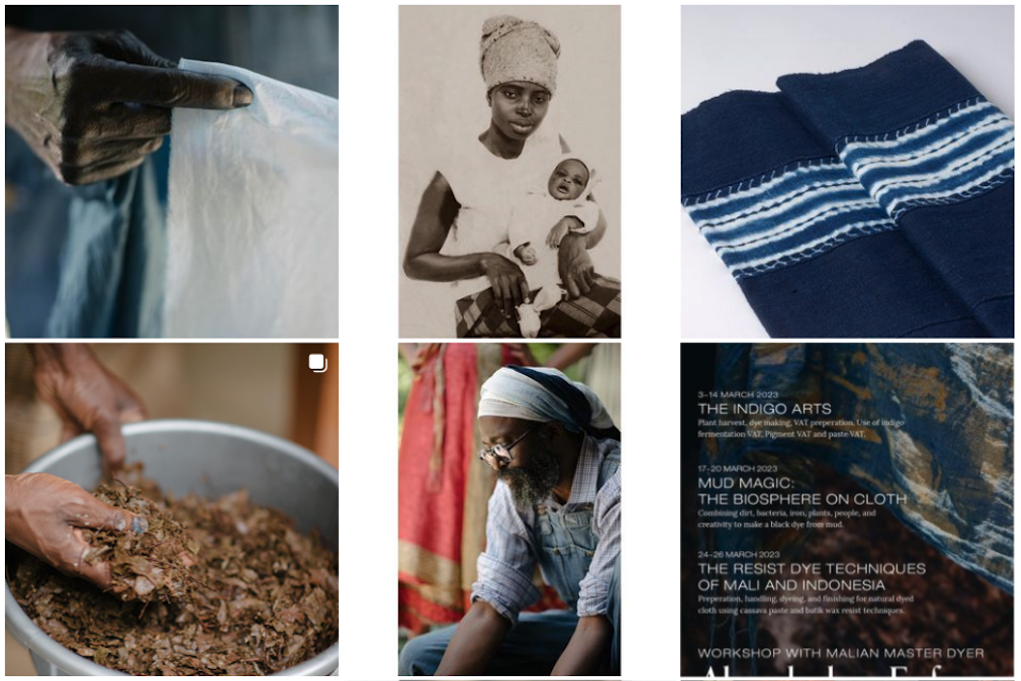
photos copyright Aboubakar Fofana, via his Instagram
And when I say known, Fofana has been written about in Vogue, the New York Times, and Selvedge magazine. He’s been feted by designers and has displayed his stunning indigo pieces and other artistic works in numerous galleries or installations. He has an atelier in the Malian capital of Bamako where he creates commission and designer pieces, all while working to build sustainable dye practices rooted in local textile heritages.
I first read about him while seeking more info about indigo dyeing and styles of indigo resist. It’s in indigo that Fofana first worked his designs and I was fascinated with his particular artistic take on it. At the same time, I’d started reading a bit more about painting with mineral mud pigments. Naturally, as soon as I heard he was offering a three-day workshop on mineral mud dyeing, online via Zoom, I jumped at the chance. No need to board a plane and take a week of vacation time from work!
Botanical Colors, a Seattle-based company that educates and supplies natural dyes to artisans, dye houses, and industrial clients, was hosting the class. The cost included a mailed kit containing an iron rich fermented mud, ground myrobalan pods, a sample of the traditional leaves used to saturate one of the fabric samples with tannins, the fabric samples themselves (finimugu and calico), and a couple of brushes to work with.
The Zoom-based workshop began with a round of introductions as we got to know our instructor and fellow classmates. Then Fofana talked a bit about the traditional Malian fabric, finimugu, that we were going to use.
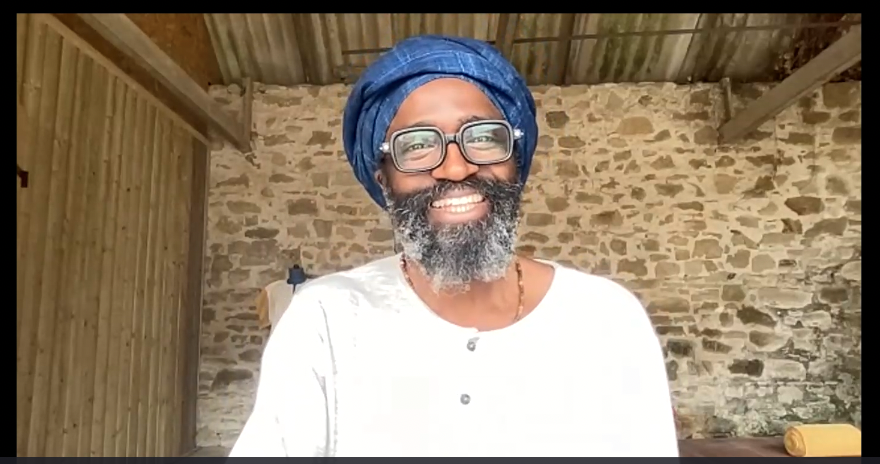
Aboubakar Fofana in Zoom, 3-Day Mineral Mud Dyeing Workshop, July 2023
screenshot used with permission from Botanical Colors
The whole process of making finimugu is fascinating, and starts with handspun cotton. The spinners, in most videos I reviewed online, used a supported spindle, constantly flicking it with one hand to impart the twist while pulling cotton fibers from a small distaff in their other hand. They could pack quite a bit of spun yarn onto those spindles! Cultural heritage groups and local NGOs have been active in arranging demonstrations by experienced spinners to demonstrate the process to beginners in order to keep handpsun skills alive.
The weavers’ loom is very compact and portable. Fofana explained that women would commission the weaver for a specific amount of fabric strips for whatever project they had in mind: general household textiles, clothing, wedding trousseaus, etc. The family would feed the weaver as he stayed with them for the duration it took to weave the commission. The width of the bands were measured by a hand spread (so, about 6 or 7 inches wide) and the order would be for a number of bands. For example, seven bands might be ordered, to be stitched together into a wrap skirt. (Fofana added that the number seven has some symbology in Malian culture.) Construction of the garments is architectural and there is zero waste. In fact, a roll of narrow bands was once used as currency because of the high value of the fabric.
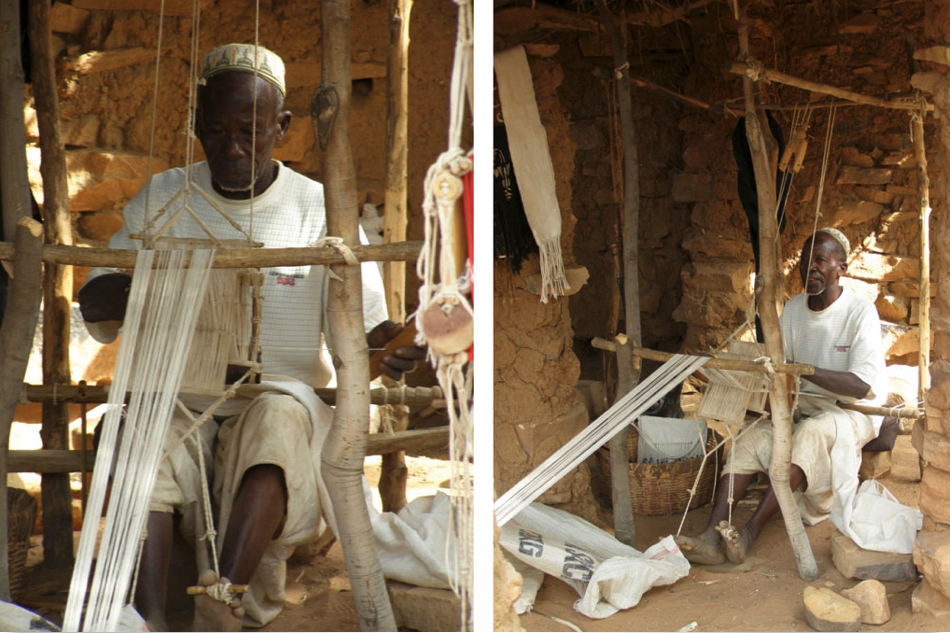
Weaver making the strips of fabric (finimugu) needed to make bogolan. Village of Songho, Dogon Country, Maili
Photos by BluesyPete, 2007. CC BY-SA 3.0
The loom is indeed small and efficient, and looks like it could be dismantled into a very compact and light set of pieces – perfect for travelling from commission to commission. In one video I could clearly see the weaver was pinching the treadle’s tie-up string with his toes for precise control. I could also see the bobbin (which is wound on from the cone by rolling a dowel on the leg) resting in a hollowed-out boat-like shuttle – which looked really comfortable in his hand. A single pulley alternated the two shafts and an ingenious setup allows him to advance the cloth and keep tension without having to get up. Winding the warp is done by unrolling the cone between stake in the ground, with the familiar cross at the end to keep everything neat when threading the heddles. The woven fabric is then rolled up into cakes when taken off the loom for use.
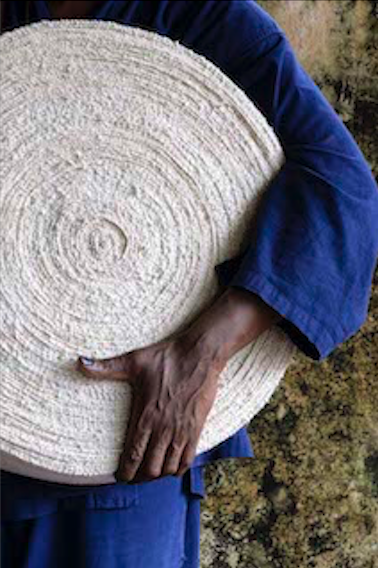
Photo via Botanical Colors
When I pulled the fabric out of the kit we were sent, I could tell the cloth had a unique character. Fofana explained that the fiber the spinners work from may still have tiny bits of the cotton boll leaves in it – this is left as is and imparts a speckled depth of color to the cloth. It looks visually sturdy but feels super soft and has a nice drape and hand to it.
Our package had two strips of finimugu – one was white and looked just as it would straight off the loom. The other was a golden yellow. It had already been prepared with a particular tannin source: the dried leaves of the n’galama (anogeissus leiocarpus), a deciduous tree native to the savannas of tropical Africa. Fofana showed us a video of the process used to soak the fabric in the tannin. I later learned that other leaves and organic materials can be used in this part of the process, imparting other colors from deep browns to vivid rust. Soaking the cloth or painting the cloth with a tannin is the first step in turning our raw finimugu into bògòlanfini (aka bogolan or mud cloth), the unique handwoven cotton fabric dyed with fermented mud that has become a symbol of Malian cultural identity.
It was also our first introduction to the concept of healing cloth. Many of the dye stuffs used, including the fermented mud, can and are used in medicinal ways. N’galama, for example, has an inner bark that is an anthelmintic and can be used for treating certain diseases in both humans and livestock, while the stem bark is full of antioxidants.1 Fofana showed us how they were sold in the local markets as small bundles. Similarly, the mud used to create bògòlanfini is considered healing, thus making the final clothing itself medicinal and spiritual. When present in the cloth, these substances impart a sense of being protected and healed by the cloth itself. Basin lan fini, or “the fabric whose result is healing.”2
Before we began painting, we were given a bit of background on the mud. It’s clay-based, rich in both iron and organic material. The Niger river is a good source and some of the best is usually found in the shallows underneath overhanging shrubs which drop their leaves into the still water, decaying to add to the organic load of the mud. A quick rub between the fingers verifies the soft and silty texture needed for painting. Once the clay is collected it is left to ferment in jars, though I wasn’t sure for how long. Fofana showed us a video of his team harvesting some mud from the river. It’s literally just scooped out of the bottom of the bank sides of the river. (The texture and scent also gave me sudden flashbacks to days spent at muddy checkpoints on the side of the Guadalupe river, waiting for racers in the Texas Water Safari, where oak trees and thick shrubs continually contribute leaves to ferment in the heat-baked mud.)
Then we were shown an example of painting with the mud. Fofana is master craftsman as well as a calligrapher who studied in Japan. I could see the latter talent when he swept a paintbrush of mud across the fabric to create a simple outline design – it had a sense of contemporary art even while being appropriately traditional. My painting with the mud comes nowhere near this when I try.
I cut my strips up into squares to try out different designs, which I actually regretted afterwards since I would have liked to sew the strips together in the traditional way. Despite the heat of the Texas summer, I did my painting outside on my back porch. (I did wait until the shade of the evening and the relative “cool” of 98F outside.) After all, the mud is fermented and has a very strong aroma – an indication of how well the mud will work as a dye and a reminder of how much organic material and living organisms go into making something with intense color. The mud dried pretty quickly after painting it on the cloth and immediately left a very nice dark color.
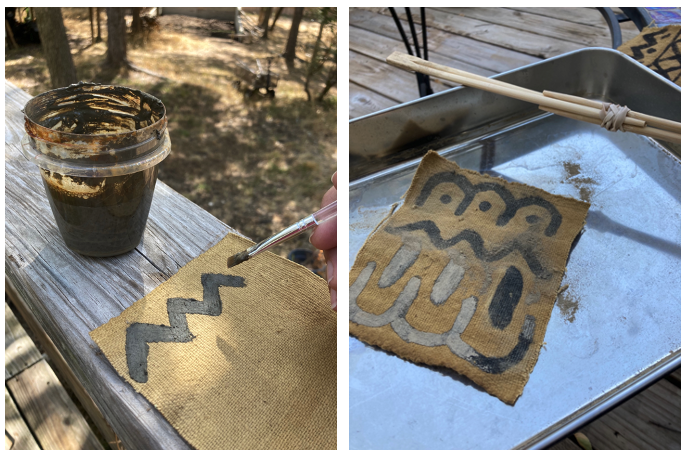
Left: Painting the wet mud on a piece of finimugu fabric that has been treated with the tannin-rich leaves first. (The tannin imparts the yellow color to the fabric.) Right: Scraping the dried mud off the fabric prior to rinsing.
Photos copyright Fazia Rizvi, 2023
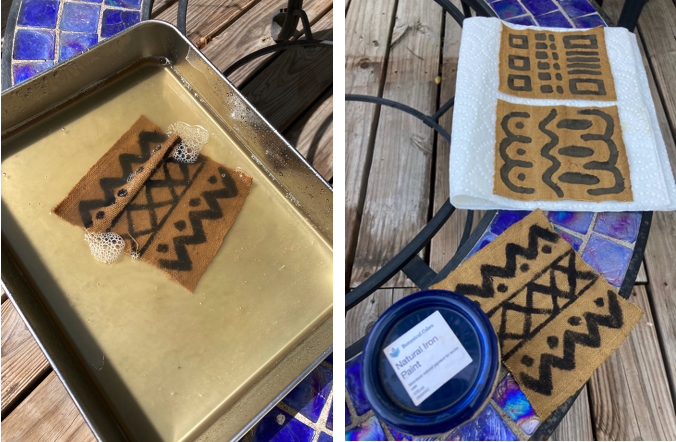
Left: Rinsing the fabric. At this point the fibers move and the piece shrinks. Right: A finished piece and two more drying.
Photos copyright Fazia Rizvi, 2023
Our kits also had a small sample of the n’galama leaves, but we did not use it for the exercises. We first painted the mud on the already prepared fabric strip – the golden one that had been pre-saturated in the tannin of the leaves. We were also provided a pouch of ground myrobalan – another natural dye and great tannin source. That one we mixed in water and used to paint faint tannin designs on our unmodified cloth strips. Once those had dried we went over the lightly yellow designs again, this time with the fermented mud. The results are a beautiful contrast between the iron-rich dark lines and the soft white of the cotton cloth.
Fofana and some of my classmates managed nice sharp edges to their designs, with no yellow halo of leftover tannin after washing. Mine look a little blurry and stained. I think it may be because the tannin designs first dried in the intense sun of our extreme heat summer and thus dyed the fabric and didn’t wash away. I’m not sure.
We were also provided a large piece of smooth calico. The instructions were to dip this fabric in the myrobalan and then let it dry. I messed this part up and left my fabric to soak overnight. Again, I dried it in the intense sunlight. That left a creamy yellow color on my fabric that wouldn’t wash out. If I had just dipped the fabric and dried it, and then painted my design with the tannin and the mud, the starches in the fabric would have protected the rest from any color. After drying and washing, I would have had an amazing crisp black and white effect. I’ll want to try this exercise again.
Class was great if at first we dealt with the dreaded microphone feedback that now seems to be a pandemic rite of passage. (It was quickly solved.) I ended up trying my leftover mud on samples of dyed fabric from other classes. (Wool, silk. Cotton loves the mud!) Other people in class tried dying gourds, leather coasters, silk and translucent cotton. It was all absolutely gorgeous.
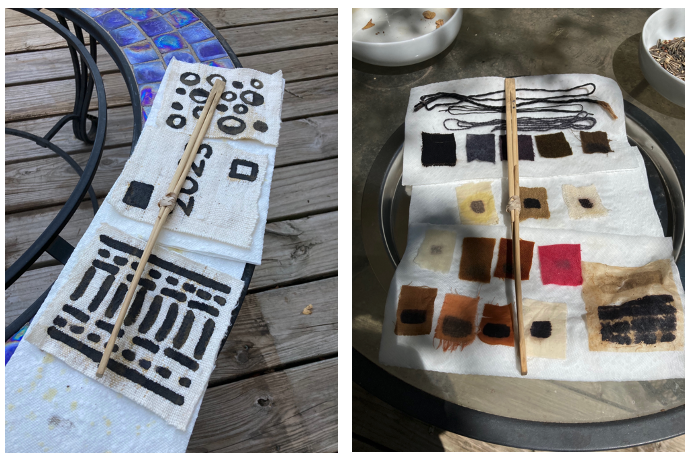
Left: Drying the second round of painted fabric. Right: Experiments with the mud.
Photos copyright Fazia Rizvi, 2023
The mud dyed designs go well with both bohemian and modern décor. In fact, I found a “Bogolanifini Linen Fabric” on one fashion website that had a “dark contrasting design inspired from the ancient handmade Malian fabric, traditionally dyed with fermented mud” selling for $465 and with the note that “All fabrics are sourced exclusively from European best suppliers and are printed in England” with no indication that any Malian, or even any African artisans or makers were involved in any part of the process or benefitted in any financial way from the product. Ah, good old cultural appropriation.
When I asked for permission to use the Zoom screenshot and one of their images in this article (originally for my weaving guild newsletter), Botanical Colors not only said yes, but offered the guild a coupon. Thank you! And thank you to Aboubokar Fofana for sharing his time and expertise with us.
For a visual of the whole process, check out these YouTube videos: “How African Mudcloth Are Made” and “The Bogolan Project”.
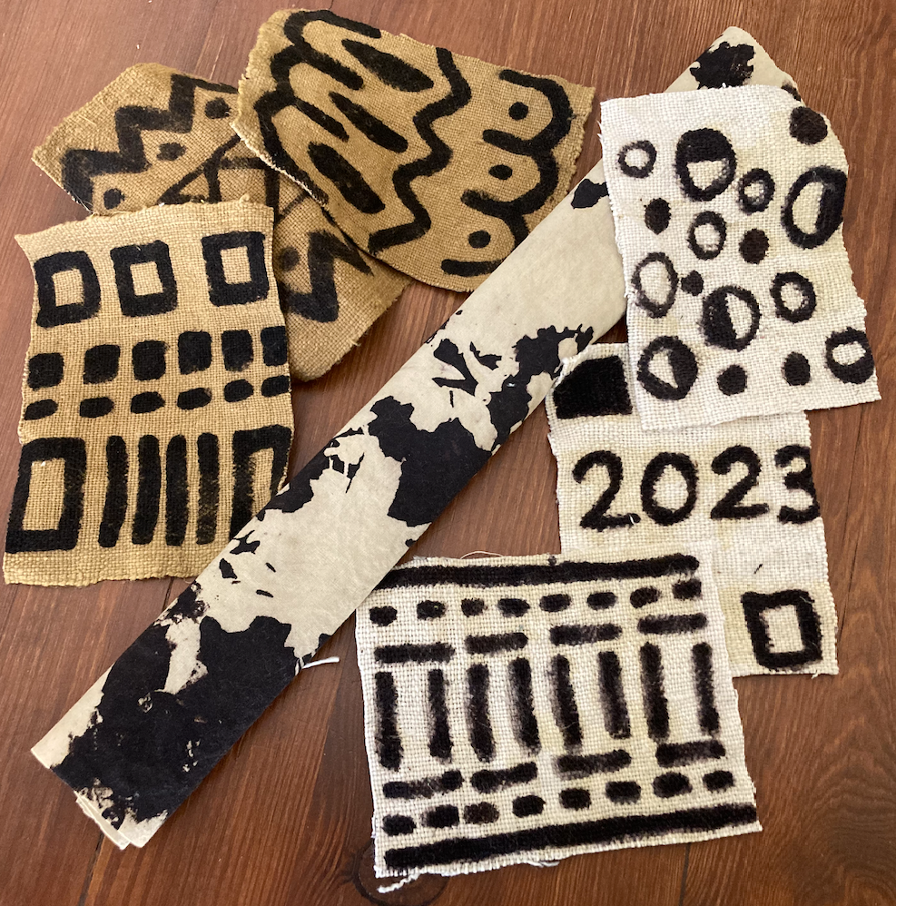
Finished classwork pieces of mineral-mud dyed cloth
Photo copyright Fazia Rizvi, 2023
- How African Mudcloth Are Made. https://www.youtube.com/watch?v=Fh6TUKkavg8 ↩︎
- Terminalia leiocarpa, African Birch, Wikipedia. https://en.wikipedia.org/wiki/Anogeissus_leiocarpa ↩︎