Sometimes it feels to me, as a relatively new weaver, that I’m on a wild joyride of unplanned and unfocused learning. I wind and weave from one fascinating technique to the next, because there are just so many wonderful things to learn, to try, and to do.
But there is one area where I remain laser focused: the tools and techniques that came from the areas of the world that my ancestors came from: my mother’s region of Karelia, in the southeast of what used to belong to Finland before World War II, and Lucknow and the parts of India north of it, where my father’s family is from.
It’s not just the techniques I’m interested in. With a background in anthropology and archaeology, I’m fascinated with the antique equipment used both as practical items and how they worked, and as cultural objects and how they fit into people’s lives.
One of the more fascinating finds of late was an interesting looking distaff.
According to Wikipedia:
A distaff (/ˈdɪstɑːf/, /ˈdɪstæf/, also called a rock[1]) is a tool used in spinning. It is designed to hold the unspun fibers, keeping them untangled and thus easing the spinning process. It is most commonly used to hold flax, and sometimes wool, but can be used for any type of fiber. Fiber is wrapped around the distaff, and tied in place with a piece of ribbon or string. The word comes from dis in Low German, meaning a bunch of flax, connected with staff.
As an adjective the term distaff is used to describe the female side of a family.
The distaff I’d stumbled across was a photograph in The National Museum of Finland’s collection online. I’d never seen anything like it. Instead of being a long simple stick or shaft, or a even a cage attached to a part of a spinning wheel, this one had a flatted oval board where the wool would have been attached. This was a rare find in the collection, since it included a length of rope and an iron spike that would have been wound around the wool to hold everything in place on the board. Even more interesting, the distaff was one single L-shaped piece, so the weaver could sit on it and hold it in place while they spun.
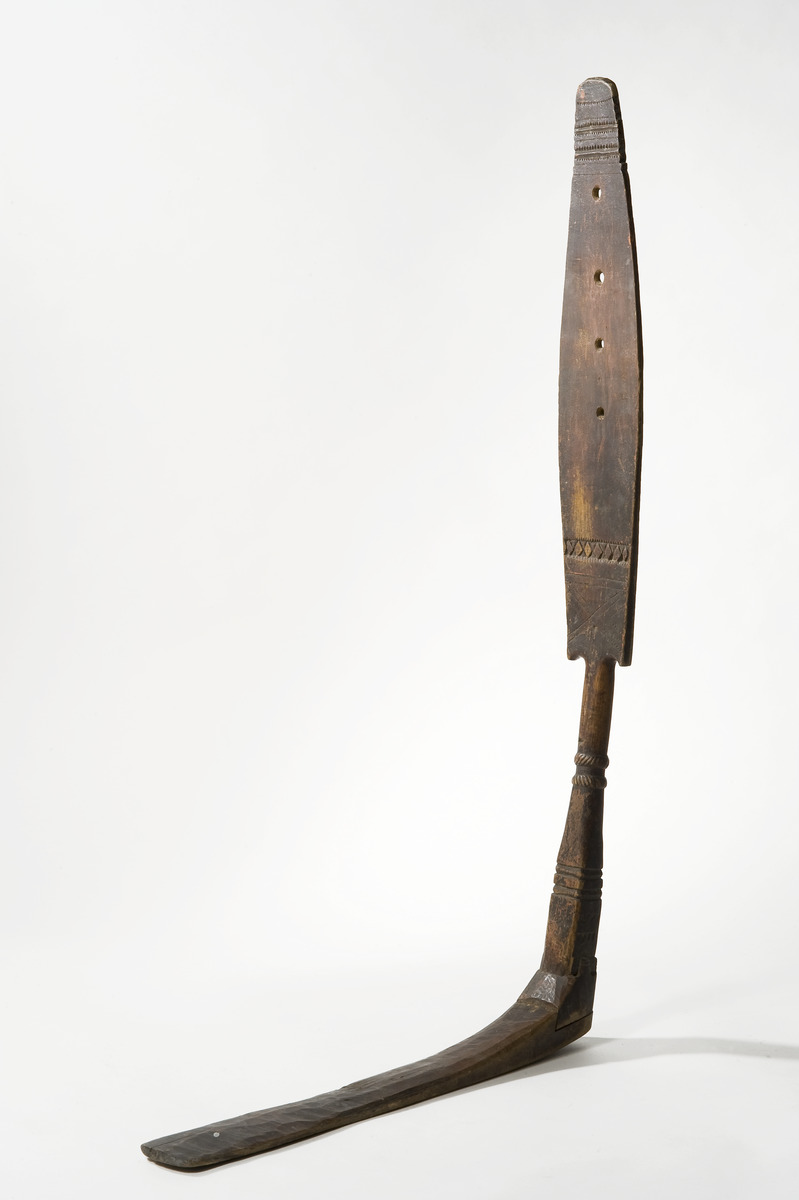
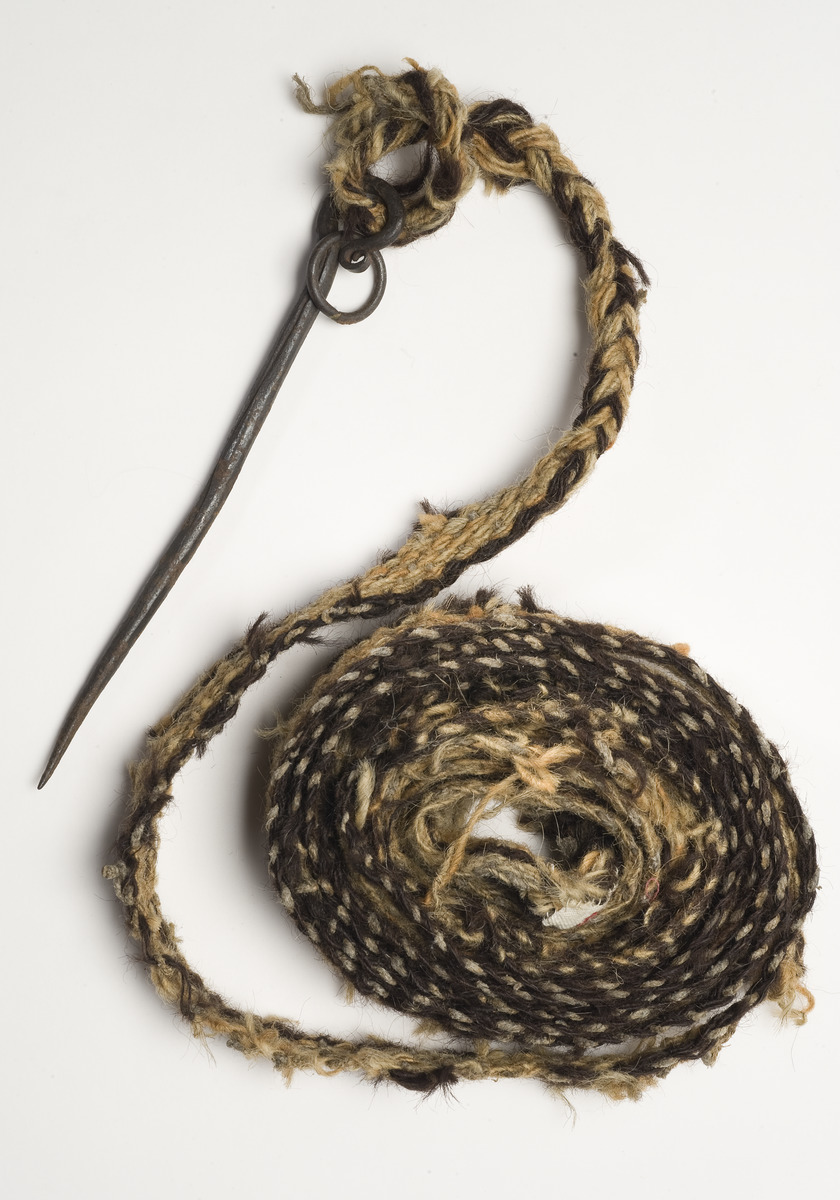
Lukkarinen, J. kehräpuu, kuontalopuikko ja kuontalonauha; kehräpuu, neula, pirtanauhaa East Karelian distaff with wool tape and needle, made sometime before 1941.
Photo via The National Museum of Finland CC BY 4.0
In Finnish, these distaffs were known as kehräpuu or, quite literally, a “spinning wood”. If I’m understanding correctly – language translations can be a bit of a barrier for me sometimes – the part of the distaff one would sit on was called jalaksen (aka “the seating board”) and the flat part that ne would tie the flax or wool to was the lapaan or “shoulder”.1
In my subsequent searches for more information, I discovered that the L-shaped distaff wasn’t confined to the area my ancestors came from. In fact, it had been in use all over Eastern Europe and parts of western Asia, from Estonia through the Slavic nations and deep into many regions of Russia (where it’s known as pryalka).
You can see a video here of how this kind of sit-on distaff is used: Distaff and Spindle
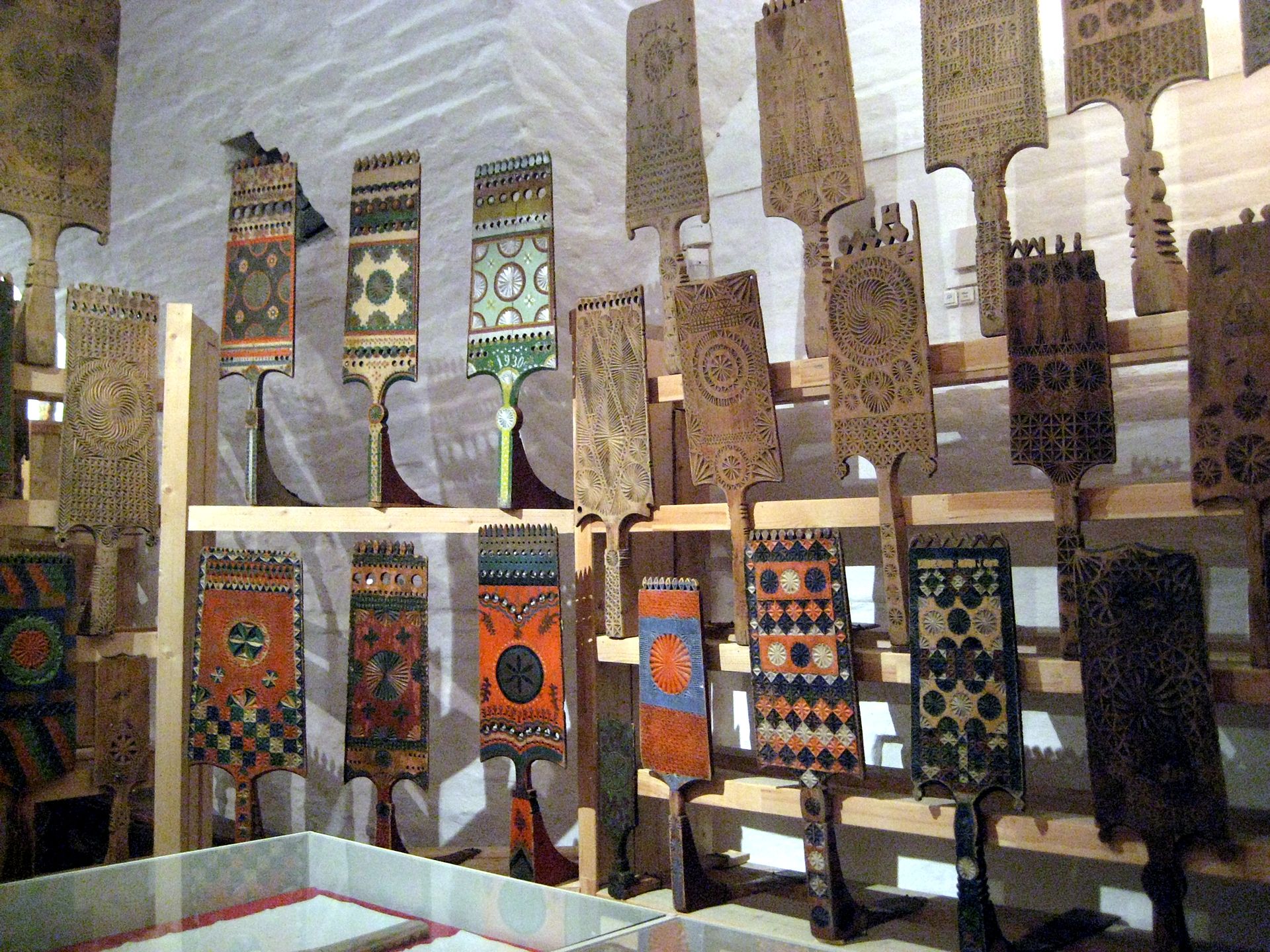
Russian distaffs displayed at the museum of folk handicrafts at Ferapontov Monastery
Image by Shakko on Wikimedia Commons. CC BY-SA 3.0

These sorts of distaffs were in use well up into the 1930s in many of these areas. Some were made as a single solid piece out of a tree trunk and tree roots. Others were made from two pieces that could be disassembled, with the decorated upright board then hung on the wall as decoration.
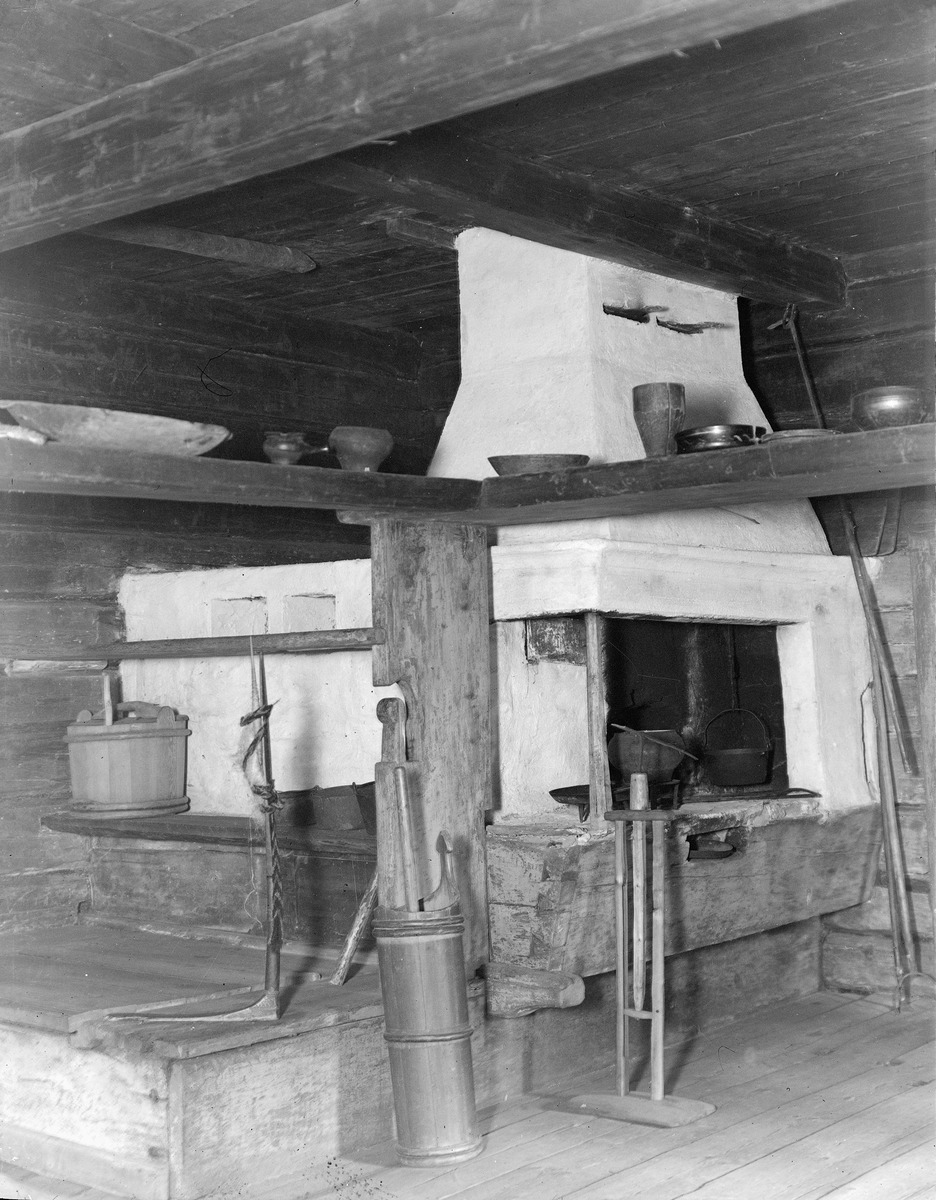
Nikkilä, E. Pertinotsa (Suojärvi Moisenvaara); pirtin uuninurkkaus.Indoor scene from Seurasaari Open-Air Museum in Helsinki, with everyday objects around the corner oven. A distaff is on the left.
Photo via the Finnish Heritage Agency and Finland’s National Board of Antiquities CC BY 4.0
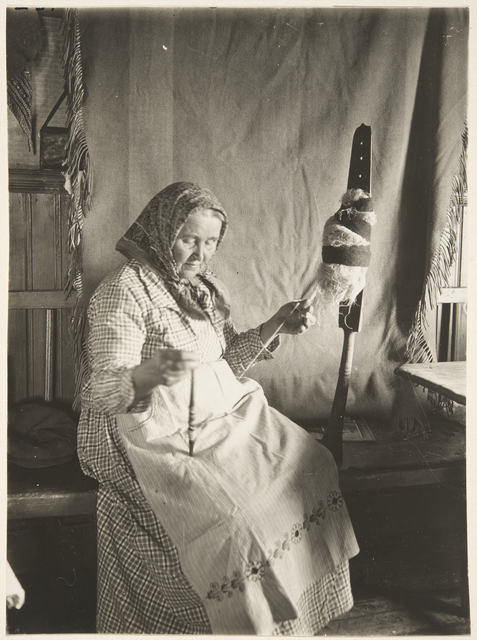
Vahter, T. majatalon emäntä Maria Kuusimäki kehrää värttinällä
Maria Kuusimäki spins with a spindle and distaff. Photographed in 1929 in the former Suistamo parish of Finnish Karelia. Photo via Finland’s National Board of Antiquities CC BY 4.0
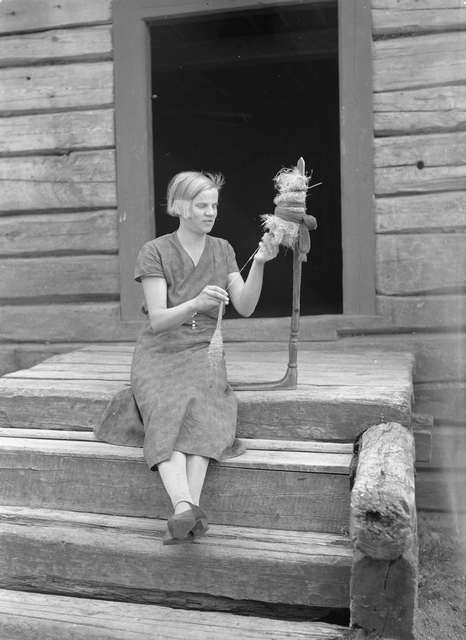
Auvo, H. Vera Mironoff näyttää kuinka “kuozalilla kegrätään”.
Vera Mironoff shows how the seated distaff is used. Photographed in 1935.
Photo via Finland’s National Board of Antiquities CC BY 4.0
At first I thought the kehräpuu of Finnish Karelia were simpler and plainer than Russian pieces, given the predominantly oval shapes and plain wood I could see in the museum objects, but now it seems that most of them were simply worn away. They were indeed painted at one time, usually in vibrant reds and greens and with designs that sometimes included flowers, leaves and birds. The sometimes ornately carved, beautifully painted but practical, objects were made by young men to give to their brides and thus also known as puukihloiksi, or “wooden engagements”.
As soon as I spied that first example in the online museum catalog I wanted one. But try as I might, I couldn’t find any modern equivalent. There don’t appear to be any artisans making anything like it today as far as I can tell. Eventually my husband promised to someday make one for me based on the archival photos. (That’ll be another essay or a blog post.)
In the meantime, I kept an eye out for any antiques that might come available. I haven’t seen one of the Finnish-Karelian style ones yet, but I did manage to find a Russian-style one on eBay recently, out of an estate sale in Ohio.
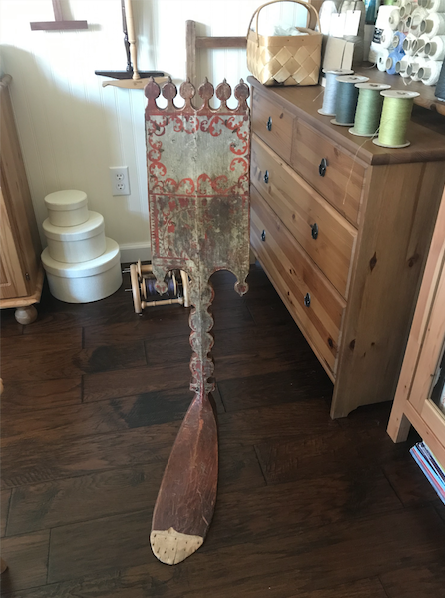
My “new” distaff as seen from the side where the spinner would sit.
Photo copyright Fazia Rizvi
In his 2012 blog post A Distaff from the Russian Arctic, Raymond J. writes about his accidental find of one similar to mine (but in much better painted condition.) You can clearly see the standard motif typical of the craftsmen of Borok, Archhangelsk oblast near the artic circle in northeastern Russia: “window panes” at the top, followed by area with a bird, and then one with horses, all on the same carved shape for the “blade” of the distaff. The inside of the blade has a blank area where possibly a mirror would be attached. If that were the case, it would explain the unusual markings I found on mine, in the same spot, that looked like something had been attached there.
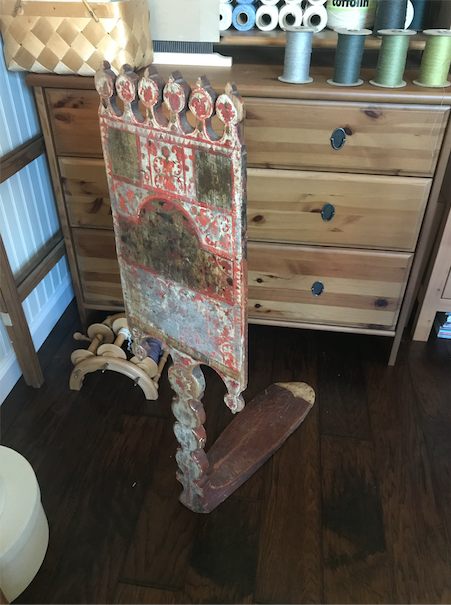
The back of the upright blade. You can see the “window panes” the arched area where a bird would typically be and the lower section where horses would typically be painted in red.
Photo copyright Fazia Rizvi
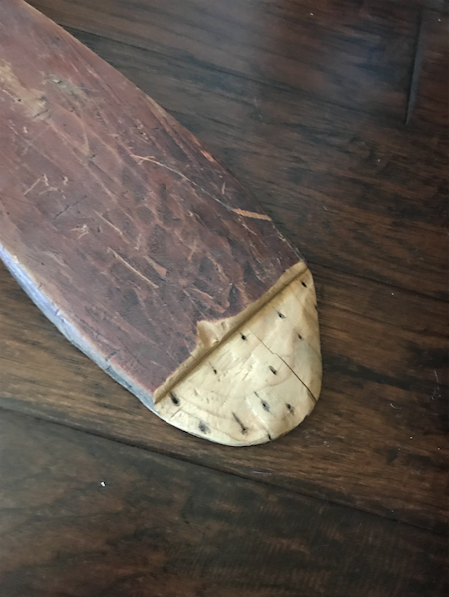
It looks like someone had nailed the end of this down, possibly to stabilize it while spinning from it. I imagine the other end could get significantly heavy when a tied with wool or flax, and if you’re not careful and get up, the whole thing could come toppling down, possibly giving you a good whack.
Photo copyright Fazia Rizvi
As for its age? What I could find about these sorts of footed distaffs seem to indicate that they’re relatively young, typically from the 19th and very early 20th century and not much older than that. 2
I look forward to spinning with mine and hope to someday lay my hands on the simpler style of kehräpuu from Finnish Karelia.
- According to the Craft Museum of Finland. Document retrieved on October 19, 2020. https://www.craftmuseum.fi/blogit/suomen-kasityon-museon-blogi/mika-kuosalin-tarkoitus ↩︎
- “Painted distaffs coming to Georgia Museum of Art”. https://news.uga.edu/painted-distaffs-georgia-museum-art/ ↩︎